
00
42
Architects and Interior Designers in Mérida — FORMM
Pablo Garza
Last updated: June 17, 2026
FORMM provides architecture and interior design in Mérida under one contract. Structural decisions — room proportions, ceiling heights, interior wall placement — are made at schematic phase alongside material selection, built-in joinery, and finish specification. Mexico's SEP credentials each practice separately; FORMM employs professionals in both. Here is what that means in practice for your project.
By Pablo Garza · Fundador y Director at FORMM Creative Group
Published June 17, 2026 · Last updated June 17, 2026
What architectural and interior design services does one firm provide together?
When one firm provides both architectural and interior design services, structural and spatial decisions — room proportions, ceiling heights, interior wall placement, and structural built-ins — are coordinated with finish specification, furniture procurement, and material selection from schematic phase onward, under one contract and one project timeline, without a handoff between separately retained architecture and interior design firms.
Mexico's federal professional licensing system, administered by the SEP, issues separate cédulas profesionales for the practice of arquitectura and for the practice of diseño de interiores — both credential types are registered on the live SEP credential portal. At FORMM, professionals credentialed in each discipline work within the same project contract. The architectural scope covers spatial design, permit drawings, and construction supervision; the interior design scope covers finish specification, furniture procurement, and the material palette.
Mexico's federal professional licensing system, administered by the SEP, issues separate cédulas profesionales for the practice of arquitectura and for the practice of diseño de interiores. Both credential types are registered on the live SEP credential portal (cedulaprofesional.sep.gob.mx). — SEP DGDGIE
What architects deliver on a residential project
An architect's licensed scope on a residential project covers the spatial structure of the building: room proportions, ceiling heights, interior wall positions, structural openings, built-in structural elements — stairs, integrated joinery, structural lighting slots — permit drawings, and construction supervision. In Mérida's concrete-dominant residential construction, all of these are decided before the permit is filed and become structural commitments once construction begins.
For new construction, the architect establishes every interior constraint the interior designer works within: ceiling heights determine furniture proportions; wall positions determine furniture layout; structural lighting recesses — coffers, coves, indirect light slots — must be positioned before concrete pours. See do architects design interiors for the full scope of what the architectural contract covers on a residential project in Mérida.
What interior designers add to the architectural scope
A specialist interior designer's scope begins where the architect's ends. The interior designer specifies the complete finish package — floor tile, wall finish, ceiling treatment, paint, and all surfaces not required by the structural permit — and handles furniture procurement, lighting fixture selection, and final styling. On a Mérida residential project, the interior designer typically engages at late schematic or design development phase, once architectural spatial decisions are fixed.
When architecture and interior design are in the same firm, the interior designer participates from schematic phase. Furniture clearances inform where walls are positioned, and ceiling heights are designed with specific furniture or lighting fixtures in mind — not constraints imposed after structural decisions are made. The result is fewer revision cycles between permit drawings and interior specification.

How do architectural decisions affect interior design options?
Architectural decisions establish the physical constraints that interior design works within. Ceiling heights set by the architect determine what furniture proportions are appropriate for each room; interior wall positions affect furniture layout and traffic flow; structural lighting slots must be positioned in permit drawings before they can be built. When both disciplines are in the same firm, these dependencies are resolved at schematic phase, before any structural commitment is made.
The sequence: spatial design before material selection
On a standard project in Mérida, the sequence is: architectural schematic, permit application, construction, then interior specification. The architect establishes spatial proportions and structural elements first. The interior designer specifies finishes, furniture, and styling after structural decisions are fixed — or, in an integrated firm, simultaneously during schematic phase, where interior requirements feed directly into architectural decisions before they are committed to permit drawings.
The sequential approach produces a specific class of expensive revision: a furniture piece that needs a higher ceiling than was built, a lighting concept that requires a structural slot the architect did not include, a kitchen configuration that conflicts with a wall position. Each revision after permit drawings are filed requires amendment drawings and municipal approval. Integration resolves these boundary decisions at schematic phase.
Where integration prevents costly revisions
Interior design revision cycles are most expensive when they require changes to structural elements already in permit drawings or already built. In Mérida concrete construction, changing a ceiling height after the slab is poured means structural revision and a permit amendment. When the interior designer participates from schematic phase, ceiling heights, wall positions, and structural lighting elements are resolved against furniture and finish requirements before the structural permit is filed.
What is included when architects and interior designers work under one contract at FORMM?
Under one FORMM contract, the architectural scope and interior design scope run from schematic phase through material specification, with a single project timeline and single point of contact. The architect handles spatial design, permit drawings, structural built-ins, and construction supervision; the interior designer handles finish specification, furniture procurement, material palette, and styling — both disciplines coordinated from day one, not handed off sequentially.
Scope element | Architecture-only contract | Interior design-only contract | FORMM integrated contract |
|---|---|---|---|
Spatial layout and room proportions | Architect determines — structural and zoning decisions | Not in scope — interior designer works within fixed spatial layout | Architect determines; interior designer refines for furniture clearances at schematic phase |
Ceiling heights and volume design | Architect — structural and permit drawings | Not in scope | Architect determines; integrated into material specification at schematic phase |
Interior wall placement (structural) | Architect — requires PCM signature per Reglamento de Construcciones del Municipio de Mérida, Art. 6 | Not in scope for non-structural; architect required for structural changes | Architect determines; PCM permit handled within same contract |
Finish specification (floor, wall, ceiling materials) | Advisory — architect selects for permit-required surfaces only | Interior designer's primary scope | Both disciplines contribute: architect determines structural surfaces, interior designer specifies finish palette |
Furniture selection and layout | Advisory at schematic stage — clearances and traffic flow | Interior designer's primary scope | Interior designer handles, coordinated with architectural clearances from day one |
Material and lighting coordination | Architect coordinates structural lighting elements (coves, slots) | Interior designer selects fixtures and palette independently | Coordinated from schematic phase — structural elements and fixture selection resolved before permit drawings |
Client coordination point | One contract, one firm | One contract, one firm | One contract, one firm — single point of contact for architecture and interior design |
Mexico cédula profesional required | Arquitectura (SEP/DGDGIE) | Diseño de Interiores (SEP/DGDGIE) — if separately credentialed | Both — FORMM employs credentialed professionals in each service line |
From schematic phase through material specification
FORMM's integrated contract starts at schematic phase with a spatial design document that confirms ceiling heights, room proportions, wall positions, and structural openings — and simultaneously flags the interior design implications of each structural decision. By the time permit drawings are filed, finish categories, furniture dimensions, and lighting concepts are aligned with structural decisions, not pending subsequent interior design review.
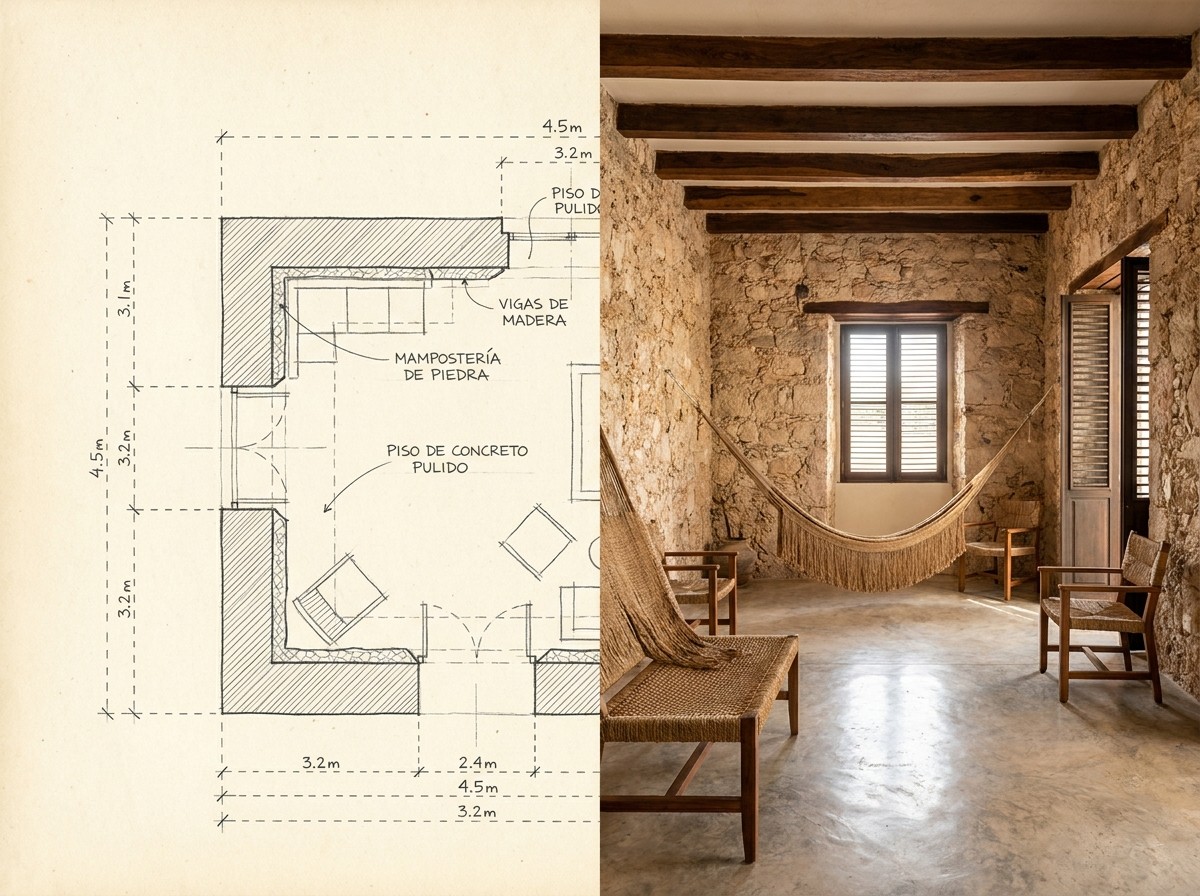
FORMM's Mérida residential projects begin interior coordination at schematic phase — ceiling heights, room proportions, and material strategy are architectural decisions made before permit drawings, not additions after the structure is closed.
What is not included and when a specialist adds value
Styling and décor — art, textiles, and final presentation layers — are outside FORMM's standard integrated scope and are quoted separately on request. For projects limited to decorating a finished space with no structural work and no permit required, a specialist interior designer working without an architect is the right model. The integrated contract is built for new construction and substantial renovation where architectural and interior design decisions must be coordinated.
For projects in scope, use the FORMM project cost estimator to get a preliminary scope and fee range. For the full overview of FORMM's architectural design practice in Mérida, see FORMM's architectural design process.
How do you choose between an integrated firm and separate architecture and interior design services?
Choosing between an integrated firm and separate architecture and interior design services depends on how closely the two disciplines need to interact on your specific project. For new construction or substantial renovation — projects requiring a building permit and involving structural decisions — integration eliminates the revision cycles that come from late-stage interior design requests changing structural commitments. For a finished space with no structural work, a specialist interior designer is sufficient.
When integration is the right model
Integration delivers the most value when the project scope includes decisions that cross the boundary between architecture and interior design: ceiling heights that affect furniture selections, wall positions that affect furniture layout, lighting concepts that require structural recesses, kitchen joinery that requires structural coordination. For a Mérida residential project — new construction, addition, or structural renovation — these boundary decisions appear on most projects and are resolved once under an integrated contract.
For clients evaluating whether a single professional can hold both credentials, see can an architect also handle interior design for how Mexico's credential system treats the two practices and when one firm is the right answer.
When separate specialists are preferable
Separate architects and interior designers work well when the two scopes are clearly divided: structural work is complete before the interior design contract begins, and interior design decisions are unlikely to prompt structural revision. This model fits renovations limited to finish changes, furniture replacement, or décor in a structurally unchanged space. It also fits when the client has a strong preference for a specific interior designer who does not work within an architectural firm.
For an overview of how FORMM structures both services in Mérida, see FORMM's architecture and interior design practice in Mérida.
In Mérida, any interior modification that alters structural elements — removing or adding walls, modifying a load-bearing element, or changing a building's interior use — requires a licensed architect to act as PCM (Perito en Construcción Municipal) per the Reglamento de Construcciones del Municipio de Mérida (Art. 6). Non-structural interior work — new finishes, paint, furniture — is exempt. — Reglamento de Construcciones del Municipio de Mérida, Art. 6 (yucatan.gob.mx, 2025 edition)
Frequently asked questions about architects and interior designers in Mérida
What are architectural interior design services?
Architectural interior design services include spatial layout, ceiling-height design, interior wall placement, structural built-ins, and material specification for permitted surfaces — delivered by an architecture firm as part of the architectural scope. Interior designers extend that scope to finish selection, furniture procurement, and styling under the same or a separate contract.
What is architectural interior services?
Architectural interior services refers to the interior-facing deliverables of an architectural contract: spatial proportions, ceiling heights, daylight strategy, structural built-ins, and permit-required material selections. The term distinguishes architecture-led interior decisions from decorator or stylist services that work within a fixed spatial envelope.
Can one firm provide both architecture and interior design in Mérida?
Yes. FORMM provides both architectural and interior design services in Mérida under one contract. Architectural decisions and interior design decisions are coordinated from schematic phase through finish specification, with a single point of contact and a unified project timeline.
What is the difference between an architect and an interior designer?
An architect designs the spatial structure of a building — volumes, proportions, structural elements, permit drawings. An interior designer specifies finishes, furniture, and décor within that spatial envelope. In Mexico, each practice is credentialed separately by the SEP; some firms hold both credentials and deliver both services.
Do architects and interior designers work together?
Yes — on most construction and renovation projects, architectural and interior design decisions interact. Ceiling heights set by the architect constrain furniture options; furniture layouts inform where walls and openings are best positioned. When both disciplines are in the same firm, these decisions are resolved before permit drawings are filed, not retrofitted afterward.
When do I need both an architect and an interior designer in Mexico?
For new construction or structural renovation in Mexico, an architect is required — a licensed architect must sign as PCM (Perito en Construcción Municipal) for permit applications per the Reglamento de Construcciones del Municipio de Mérida (Art. 6). Interior design services become most valuable when the project scope extends beyond structural completion into finish specification, furniture, and fitted interiors.