
00
41
Do Architects Design Interiors? Yes — Here's the Scope
Pablo Garza
Last updated: June 15, 2026
Yes — architects design interiors. When you hire a licensed architect in Mérida, interior spatial decisions — ceiling heights, room proportions, where walls and openings fall — are architectural decisions, not delegated to a separate specialist. Mexico's SEP registers "Arquitectura" as a regulated credential covering integrated design. Here is the exact scope and where specialist interior design adds value.
By Pablo Garza · Fundador y Director de FORMM Creative Group
Published June 15, 2026 · Last updated June 15, 2026
What interior design work is included in an architectural scope?
Architects design interior spaces as a core part of their licensed scope. Room proportions, ceiling heights, spatial flow, structural openings, and built-in elements like staircases are all architectural decisions — resolved during schematic design, before any finish selection or furniture specification begins. For the credentials question, see can an architect and interior designer be the same person.
Spatial planning, volumes, and proportions
Interior space quality — how large a room feels, where natural light enters, how ceiling heights shift from space to space — is determined at the architectural design phase. The architect establishes the spatial envelope of every room: floor area, ceiling height, proportional relationships between connected spaces, and where structural walls and partitions fall. Once recorded in permit drawings, changing these proportions requires a new permit application.
Openings, built-ins, and structural interior elements
Beyond spatial planning, architects design the structural interior elements that define how a space is experienced: door and window openings that control light and movement, staircases, structural columns within interior spaces, kitchen and closet joinery integration at the structural level, and the structural recesses for lighting elements like coffers, coves, and indirect light slots.
These elements are architectural because they require permit drawings and structural coordination. In Mérida's concrete-dominant residential construction, they cannot be repositioned without structural revision and permit amendment — the architect owns these decisions.
Mexico's SEP registers "Arquitectura" as a regulated profession via the DGDGIE — architects must hold a cedula profesional to practice, while "Diseño de Interiores" is not a regulated profession under the Ley Reglamentaria del Artículo 5° Constitucional and requires no federal cedula to practice. — Ley Reglamentaria del Artículo 5° Constitucional (diputados.gob.mx)
What interior design is NOT automatically part of an architectural scope?
Finish specification, furniture procurement, and styling are not part of a standard architectural scope. An architect selects materials where structural permits require it; a specialist interior designer builds the full finish package — floor tile, wall finish, fixtures, furniture, and décor. See interior architecture vs. interior design in Mérida for a detailed comparison of how these scopes differ.
Finish specification, furniture, and styling
The scope boundary follows a clear logic: architects specify what must be permitted or structurally constrained; interior designers specify everything else.
In Mérida's residential projects, the standard architectural scope includes permit drawings, structural specifications, and supervision of construction elements requiring a signed permit. Finish materials required by the permit — waterproofing specifications, concrete floor slab thickness, exterior cladding affecting structural loads — fall within the architectural scope. Floor tile selection, wall paint, cabinetry hardware, and furniture do not.
When a specialist adds value beyond the architectural scope
A specialist interior designer extends the project's scope in three areas the architect's contract does not typically cover:
Full material finish package: complete specification of every surface — floor tile, wall finish, ceiling treatment — including supplier coordination and construction-phase oversight.
Furniture specification and procurement: selecting, sourcing, and coordinating delivery of every furniture piece, including bespoke joinery not structurally integrated into the building.
Styling and décor: art, textiles, lighting fixtures (as distinct from the structural lighting slots the architect positioned), and the final presentation of the interior.
For projects where structural and spatial decisions are handled by an architect, adding a specialist interior designer extends finish and styling depth — at an additional contract cost.
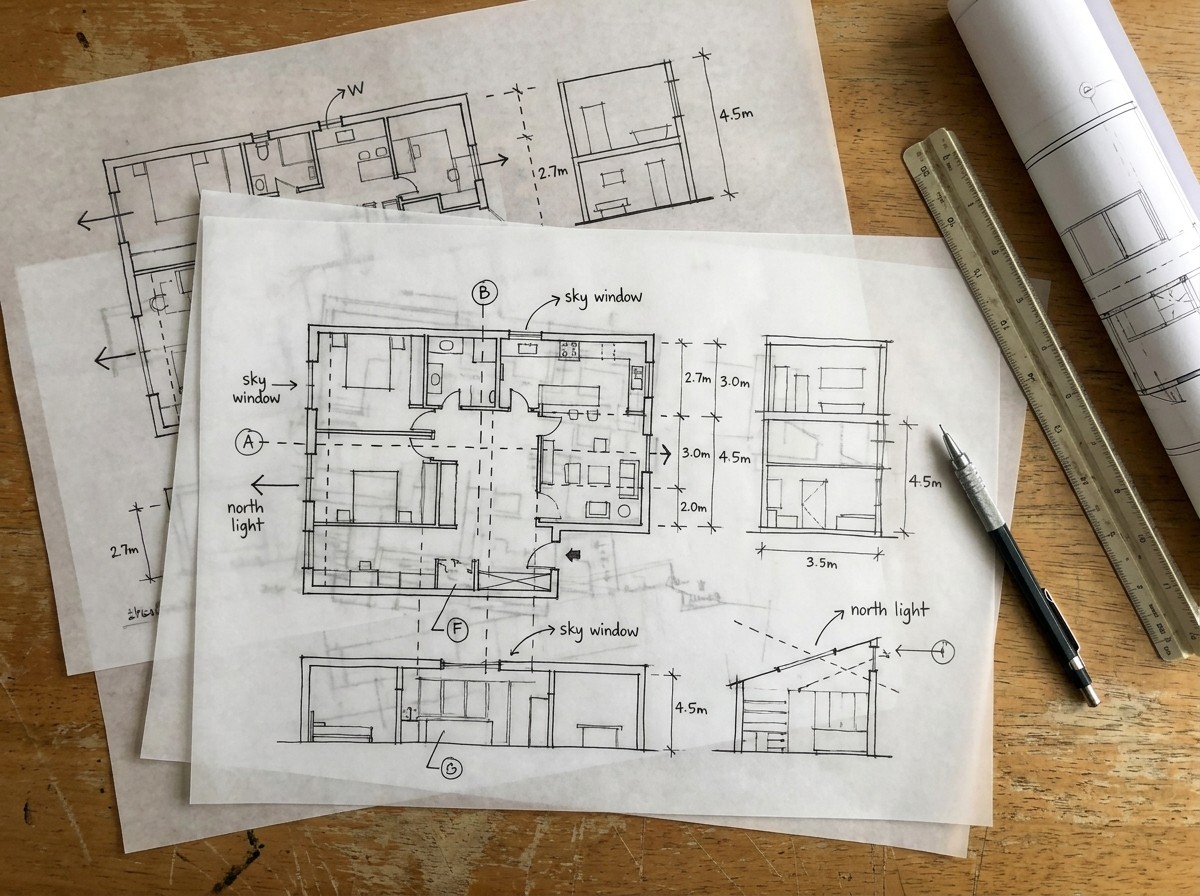
Interior scope element | Included in architectural scope | Specialist interior designer adds |
|---|---|---|
Room proportions and ceiling heights | Architect determines — part of structural and spatial design | Interior designer may refine for acoustic or lighting effect |
Interior wall placement | Architect — structural and zoning decisions | Interior designer — partition suggestions for non-structural walls |
Door and window placement (openings) | Architect — structural loads, permit drawings | Interior designer may request repositioning for furniture layout |
Built-in joinery layout (stairs, wardrobes) | Architect designs integration — structural fixings, clearances | Interior designer specifies finishes, hardware, material palette |
Finish specification (floor, wall, ceiling materials) | Architect selects for permit-required surfaces; otherwise not primary scope | Interior designer's primary scope — full material-finish package |
Furniture selection and layout | Advisory at schematic stage — clearances and traffic flow | Interior designer's primary scope — furniture procurement and specification |
Lighting design (fixture placement and types) | Architect positions structural lighting elements (coves, slots) | Interior designer coordinates fixture selection and placement |
Color and décor | Not primary architectural scope | Interior designer's primary scope |
DRO permit signature (Mérida / IMIP) | Architect only — required for structural interior modifications | Interior designer not eligible to sign as DRO |
When does Mérida law require an architect for interior modifications?
In Mérida, any interior modification that alters structural elements — removing or adding walls, adding a floor, changing a load-bearing element — requires a licensed architect to act as PCM (Perito en Construcción Municipal) under the municipal construction regulation. Non-structural interior work — paint, floor tile replacement, finish changes that do not affect structural elements — does not require a building permit.
Structural changes and PCM requirements
Mérida's Reglamento de Construcciones del Municipio de Mérida (Article 6) requires that any project needing a municipal building permit be signed by a PCM — Perito en Construcción Municipal — who must hold a cedula profesional as Arquitecto, Ingeniero Civil, or an equivalent regulated engineering profession. The PCM takes legal responsibility for compliance with the construction regulation and signs both the permit application and the construction drawings.
Interior modifications that trigger the permit requirement include: removing or adding load-bearing walls, adding a structural floor level, modifying a structural column, changing a building's use classification, or any modification that affects the structural system. Each requires PCM signature before work can begin. Interior designers are not eligible to serve as PCM — Article 6 lists Arquitecto and Ingeniero Civil among the qualified professions; interior design is not included.
Mérida's Reglamento de Construcciones (Art. 6) requires a licensed architect or engineer as PCM on any permit-required structural project; Art. 32 explicitly exempts paint, floor replacement, and non-structural finish repairs that do not affect structural elements from the permit requirement. — H. Ayuntamiento de Mérida, 2025 edition (yucatan.gob.mx)
Which interior changes do NOT need a permit
Article 32 of Mérida's Reglamento de Construcciones exempts from permit requirements: interior and exterior paint; floor replacement when structural elements are not affected; repairs to finishes and systems not touching the structure; and non-structural interior partitions in commercial spaces whose weight was considered in the original structural design.
A homeowner replacing tile, repainting rooms, updating kitchen finishes, or adding a non-structural partition can do so without a permit. The PCM requirement applies only when structural elements are modified.
What does FORMM include in its interior design scope?
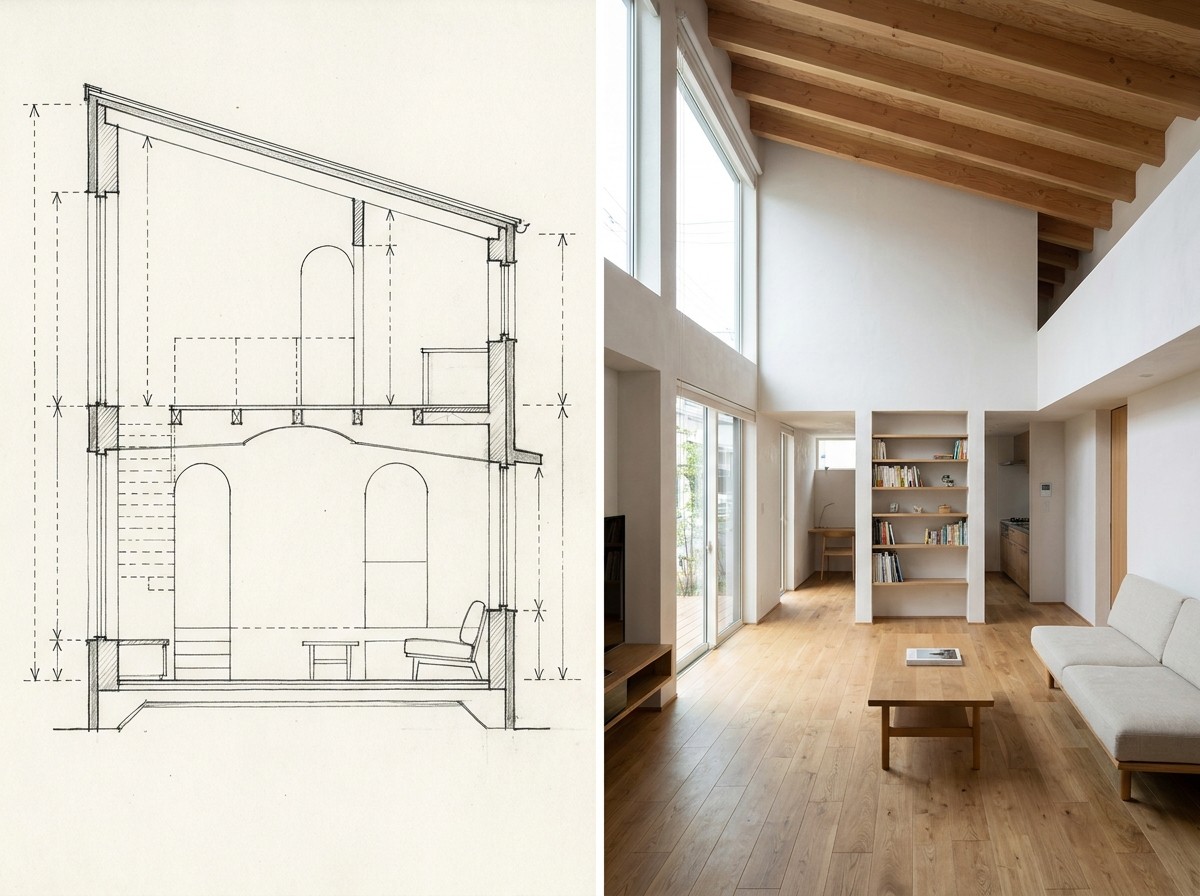
FORMM integrates interior spatial design into the architectural scope from the schematic phase. Ceiling heights, room proportions, daylight entry points, and built-in joinery positions are architectural decisions established before permit drawings are filed. On projects requiring a deeper finish specification, FORMM expands to a dedicated interior design service line.
How interior design is integrated at the schematic phase
FORMM's Mérida residential projects begin with interior spatial design at schematic phase — ceiling heights, daylight strategy, and built-in positions are architectural decisions made before permit drawings are filed.
At schematic phase, FORMM determines how natural light enters each space across the day, where ceiling heights shift to define spatial hierarchy, how structural built-ins integrate with the structural grid, and how exterior spaces connect to interior rooms through opening placement. These are structural decisions embedded in the permit drawings — an interior designer who joins after permit approval works with them as fixed constraints.
FORMM's architectural design process details each project phase from schematic design through construction documentation and site supervision in Mérida.
When FORMM recommends adding a dedicated interior design service line
FORMM recommends a dedicated interior design service line when a project requires a fully specified material finish package, bespoke furniture procurement, or a complete décor program that goes beyond what the architectural scope delivers.
The trigger is scope depth and project intent. For a residential project focused on construction quality and spatial design, the architectural scope delivers what most clients need. For a project being finished for a specific purpose — a curated primary residence, a short-term rental, or a property being professionally photographed — the interior design service line ensures finish specification and procurement match the rigor of the architectural scope.
FORMM's Mérida residential projects begin with interior spatial design at schematic phase — ceiling heights, daylight strategy, and built-in positions are architectural decisions made before permit drawings are filed. — Pablo Garza, Fundador y Director, FORMM Creative Group
Use the FORMM project cost estimator to scope the budget for your project in Mérida, including architectural scope and any additional interior design service lines.
Frequently asked questions
Do architects design interiors?
Yes. Architects design interior spaces — room proportions, ceiling heights, spatial flow, door and window placement, and structural built-ins are all architectural decisions. The question is depth: a licensed architect delivers interior spatial design; a specialist interior designer extends that into finish specification, furniture procurement, and styling.
What interior design do architects do?
Architects determine the spatial quality of interiors: how large rooms feel, where natural light enters, how ceiling heights vary from space to space, and where structural built-ins like stairs and kitchen joinery are positioned. These decisions happen during schematic design, before any finish or furniture selection begins.
Do I need an interior designer if I have an architect?
It depends on project scope. If your project involves new construction or major structural renovation, an architect handles the spatial design. If you also want a fully specified finish palette, bespoke furniture procurement, or a styled interior, an interior designer adds significant value alongside or after the architectural scope.
What is the difference between architectural interior design and interior design?
Architectural interior design refers to decisions made at the structural and spatial level — volumes, proportions, openings. Interior design as a separate discipline covers finish selection, furniture, and décor. On most projects the two overlap; on FORMM's integrated projects they are delivered by the same team under one contract.
Does hiring an architect include interior design in Mexico?
In Mexico, an architect's cedula profesional covers the practice of arquitectura — which includes interior spatial design as part of the architectural scope. Finish specification and furniture procurement are not part of the standard architectural cedula scope but can be offered as additional services by the same firm.
When does an interior modification in Mérida require an architect?
In Mérida, any interior modification that alters structural elements — removing or adding walls, adding a floor, changing a load-bearing element — requires a licensed architect to sign as Director Responsable de Obra per IMIP requirements. Non-structural changes such as new finishes or furniture do not require a permit or architect sign-off.